Friday, 4 July 2014

40. KILN OPENING FOR THE OPEN STUDIO EXHIBITION

Hello Potters and Friends,

The Warwickshire Open Studio Exhibition has come round again and, as last year, I have a joint exhibition with my daughter - jeweller Rosie Bill and painter Kathy Webster.


Turning my studio and Alan's study into a gallery always takes several days of hard dusting, window cleaning and emptying. The rest of the house acts as a warehouse for the unwanted items but, hey, it's a very enjoyable 2 weeks. 


So a couple of weeks ago I had a kiln opening and here is a close look at a few of the contents.

Continuing the naked clay theme that I talked about in the previous post, I enjoyed experimenting with red iron oxide.


After a bisque firing I painted on a wash of red iron, then removed most of it with a damp sponge. Then when it was bone dry, I rubbed it carefully with sandpaper to bring back some of the white clay. I used a brush-on glaze to confine the pool of glaze to the centre. 

The edge was imprinted with various objects including a lump of lava from Lanzarote and red Monopoly houses.


The ginger jars have attracted a good deal of attention. The insect decoration was painted with very thick iron oxide.


And here's a wonderfully happy accident.......


I brushed on white slip at leather hard stage, then burnished it with the back of a spoon until I achieved a good shine. Then I painted my fern on top with thick red iron oxide. 
It came out of the bisque kiln as I imagined. I glazed the inside and fired it to cone 6 (approximately 1230ÂșC) and I had, quite by chance created this crackle effect.


I've no idea why this happened. Something shrank, but was it the slip or the oxide? It's a mystery to me, but I will certainly be doing it again. I love it.

But I haven't abandoned glazes altogether. These Charwan teacups present quite a splash.


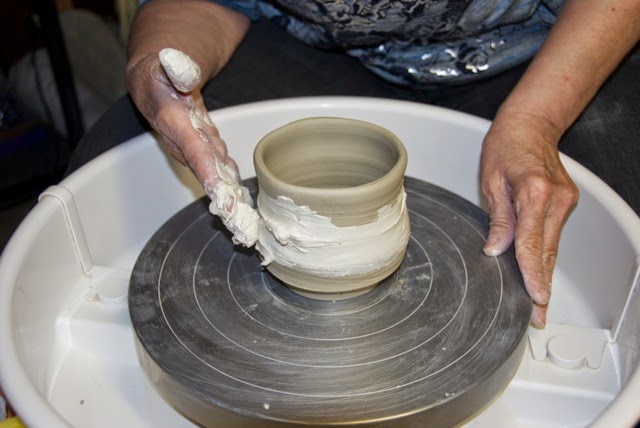
Thrown stoneware with a handful of porcelain dragged around the middle (previous post shows me making a Yunomi cup in the same way).

Charwan and Yunomi teacups are made without handles so that the temperature of the tea can be felt when picked up. If the cup is too hot to hold then it's too hot to drink and therefore bad for the digestion. 

And on this ginger jar is a mixture of glaze and a highly flecked clay surface.


But what caused the biggest celebration in our household this week is the birth of another grand-daughter. Welcome to the family, Lana Quinn Kennedy.

HAPPY POTTING FOLKS 


Saturday, 3 May 2014

39. THE NAKED CLAY ROUTE AND BEYOND.

Hello Potters and Friends,


Here I am exhibiting in a mixed art and craft fair in Chipping Campden, in the heart of the picturesque region of the Cotswolds.


Here we have village after village of stone cottages built beside shallow, fast running streams that reflect all the surrounding beauty. And, of course, a constant crocodile line of tourists.
So as well as chatting to the visitors about my methods and techniques, I was also looking at my work as a whole and feeling the need for a bit of a change. I'm not unhappy with what I've been making, but sometimes (as my mother would often say) 'a change is as good as a rest'.

So first off, Alan offered to make significant changes to my website and get all my work bang up to date. I love it, and you can take a look here.

And in the workshop during these past few weeks, this is more of what I'm going for -


More naked clay and less glaze. The decoration is a velvet underglaze.

I then progressed on to this -


A thrown stoneware cup with great dollops of porcelain smeared on.


This is a Japanese cup called a Yunomi. Although deliberately made misshapen, as if not wheel thrown, it should still give the impression of being made with skilled hands. So I'm prodding and squeezing all over the place and somehow it's really freed me up. It's like going back to that beginner stage again, where everything is new and exciting. 


I've put aside the glossy glazes for a while and dug out a matt one that I haven't opened up for some time. I applied it with thick and quick brush strokes, as on these stoneware buttons.


And I've dirtied up my pristine white porcelain brooches by mixing in some black clay. The cutter I used for this I bought in the cake-making department of a local store.

And finally, from an old ceiling light fitting that I came across in our junk room ...


 I rubbed on a thin coating of Vaseline, lay stoneware clay over it, and I've just put this together with a wheel thrown foot -


I heartily recommend going for some changes to give yourself a rest!

HAPPY POTTING FOLKS.


Sunday, 2 March 2014

38. BACK TO THE EARTH.

Hello Potters and Friends,

Lanzarote is one of the Canary Islands off the coast of Morocco, and its most notable feature is that it's covered in black volcanic lava. Every house is painted white, by law, thanks to the artist Cesar Manrique who had a major influence on planning regulations and achieved sympathetic development of tourism from the governing body.
The result is a beautiful black and white landscape, and one that Alan and I love.


We visited there last month with our daughter Rosie and grandson Hector. And I think it's no coincidence that most of the pots I have just taken out of the kiln have been black or white.


I recently saw a photograph of some quite small plates about 5inches in diameter, and they reminded me of the small plates my grandmother served slices of cake on. In fact she called them cake plates. So I thought I would introduce the idea of a plate for this sole purpose into my next exhibition. 


I love making jugs. I used a few brush strokes of oxide to create the pattern on the right-hand jug. It could be a boat or moth or nothing at all, but I liked it so much that you'll see it again, make no mistake. The other two are Grab Jugs (no handles) They are always popular, I can never make too many.


A spot of hand-building. The ends were cut then overlapped. It creates a more oval shape than this photo shows. So here we are.....


The same technique and this one was stamped with two Indian wood blocks that I bought in the old town of Teguise in Lanzarote.


Alan, Rosie and Hector outside the shop


Here's that mothy, boaty pattern again. You may have seen my sweet potato mould I made a while ago. I've never found a better, more knobbly vegetable. The top is an added thrown piece. 


OH WOW COLOUR !  Wax painted on before glazing gives a very rough and ready effect. I dipped them in Tenmoku when the wax had dried out.


This was a complete surprise, but a welcome one. I had painted on small oxide dots before the bisque firing.  (Manganese and copper carbonate) However, when I had dipped it in a glaze called Marguerite and placed it on the bottom shelf of the kiln (the hot spot in my kiln) the dots became streaks. Brilliant. But can I ever achieve this again???

And finally......a moment of madness.


The fishing boat, bobbing seaside pot.
I can only say.....


HAPPY POTTING FOLKS


Mi amigo.


Monday, 20 January 2014

37. GONE COLOUR CRAZY

Hello Potters and Friends,

I sat at the wheel after the Christmas break with the intention of throwing a couple more teapots and tea bowls. The clay was a tad cold in the workshop but with the help of a little warm water the throwing was going well and to plan. I started with the tea bowls just to get me into a nice rhythm.

This was my intention.....


But this was what transpired.........


And not just one........


Thrown as a cup, then squashed, pinched on one side, and then adorned with mini birds, teapots etc.
Before the bisque firing I painted them with underglaze colours. 

I find these small pots of underglaze colour quite difficult to judge because what is painted on the pot completely changes once a clear glaze is added.
This is one that changed dramatically after being glazed.

Before... quite fun.


After....not what I imagined!


But I did manage to throw one teapot.


But I mistakenly picked up Lava clay instead of speckled clay which is why it's doubly speckled!!
Good job my white glaze is very adaptable.
And I cut the spout a bit too low, so a full pot of tea will result in a little bit of spillage from the spout. As I've said before, the tip of the spout should be on a line with the rim of the pot to prevent this. So why didn't I heed my own advice? This is a question I often ask myself.
So from that week's work I found that the only thing I really liked was the outline of two apples that I painted with manganese on the teapot. 
Ah well, you can't win 'em all.

But here are a couple of little tricks I played around with.

Roll a ball of clay in your hand and then, in a circular movement, roll a piece of flat plastic over it.


I used the base of a take-away tub.

And this is the result..


Just like that.
And as you saw, I stuck it on the nose of my bird vase.

And here is a great aid to any hand-builder.


It is very flexible, but at the same time it will not move from the shape you finally put it in. I believe most art shops sell them. I created these two perfect curves by cutting round it. 

And finally, here is my little Russian angel that I made for Christmas. But she'll probably stay out on the shelf for the rest of the year.


HAPPY POTTING FOLKS

KEEP PRACTICING AND
KEEP "EM COMING


Saturday, 30 November 2013

36. BLACKBIRDS, TEAPOTS AND HOLKEN HALL - BUT NOT IN THAT ORDER.

Hello Potters and Friends,

While my kiln was working away on a glaze firing, Alan and I went on a trip northwards for a couple of days to the Lake District.  Just south of Lake Windermere to be exact.  Cold? Oh yes, I should say so, but very beautiful.


And we visited Lord and Lady Cavendish at Holken Hall.
We don't know them personally, of course, but we paid our money and had a good nosey around their castle-like home. 


Below is the vast library where Queen Mary spent many hours hiding from the paparazzi after her son, King Edward VIII, announced his love for US divorcee, Wallis Simpson, and expressed his intention to abdicate the throne in the December of 1936. 


And here is the dining-room where she probably found it hard to enjoy a single mouthful of that year's Christmas lunch.


I hope they remove the enormous floral display before the turkey arrives! Some parts of that could poke your eye out.

But it was lovely to return to our humble abode and have a look at what was waiting in the kiln.

The two teapots that I made in the previous post came out very well. And I've made some small cups to match them.


I have been trying out a much darker green glaze called Northern Woods. 
(Very appropriate to this post, I now realise)


I have been making lots of these little blackbirds and putting them in a plastic lidded container to keep damp for when I need them. They'll stay just as I made them for a couple of weeks – maybe even more if well sealed.


I painted them with manganese to get this bronze/metallic look. And I fixed them on with paperclay slurry. (See previous post for paperclay recipe.)
This glaze shows texture really well.


To create the sgraffito markings I used a sharp pencil. This works better for me than a needle or other potters' tools. I feel that I am really drawing by using a pencil and I never feel that with other tools.


Bits of clay stick in the markings as you make them, but just leave them until the pot dries out a little and then brush them off with a stiff paint brush. 


And finally, my obsession with adding beads to everything is still with me.


HAPPY POTTING FOLKS